Why Instrument Rating (IR) is Essential for Commercial Pilots
In the aviation industry, safety, precision, Instrument Rating (IR) and professionalism are critical for every flight operation. While obtaining a Commercial Pilot License (CPL) is a significant milestone, it is often not enough for pilots who want to build a successful career in commercial aviation. One of the most important qualifications that enhances a pilot's skills and employability is the Instrument Rating (IR).

An Instrument Rating allows pilots to fly aircraft using flight instruments rather than relying solely on visual references outside the cockpit. This capability is essential when operating in poor weather conditions, low visibility, clouds, or during night flights. For commercial pilots, an Instrument Rating is not just an additional certification—it is a vital requirement for safe and efficient flight operations.

What is Instrument Rating (IR)?
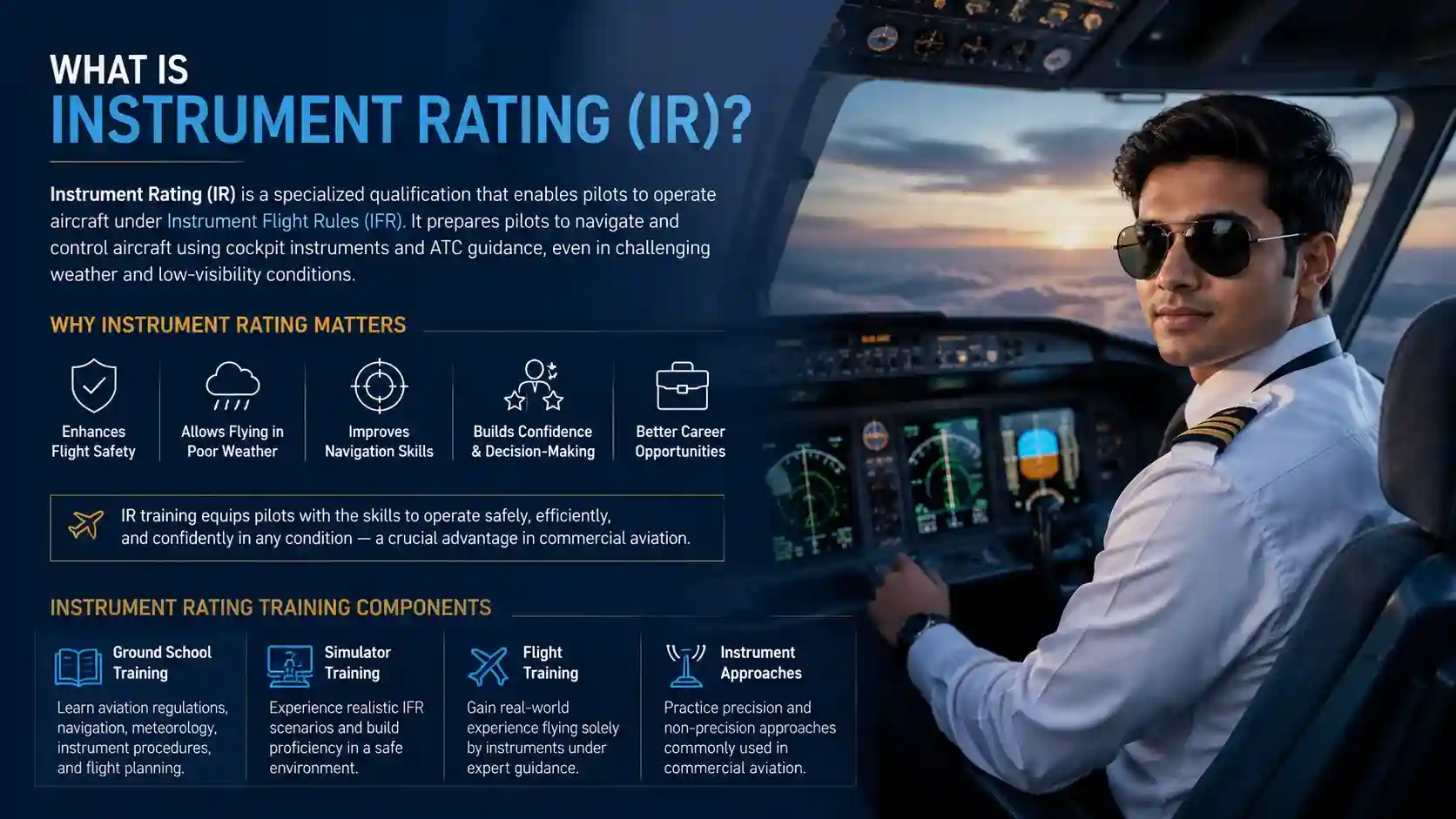
Instrument Rating (IR) is a specialized qualification that enables pilots to operate aircraft under Instrument Flight Rules (IFR). Under IFR, pilots navigate and control the aircraft primarily using cockpit instruments and air traffic control guidance rather than visual landmarks.
This rating is designed to prepare pilots for situations where visual navigation is limited due to weather conditions such as:
- Heavy rain
- Fog
- Clouds
- Haze
- Low visibility
- Night operations
With Instrument Rating training, pilots learn how to safely manage aircraft in challenging environments while maintaining accurate navigation and flight control.
Why is Instrument Rating Important?
Commercial aviation operates on strict safety standards. Airlines and aviation organizations require pilots to be capable of handling a wide variety of weather and operational conditions.
Instrument Rating helps pilots:
-
Improve flight safety
-
Increase operational flexibility
-
Enhance navigation skills
-
Meet airline hiring requirements
-
Build confidence in adverse weather conditions
Without IR training, a pilot's operational capabilities remain limited to favorable weather and visual flight conditions.
Enhances Flight Safety
Safety is the primary reason why Instrument Rating is essential for commercial pilots.
Weather conditions can change rapidly during a flight. A pilot may encounter clouds, thunderstorms, fog, or reduced visibility unexpectedly. Without proper instrument training, such situations can become dangerous.
Instrument Rating equips pilots with the skills needed to:
- Maintain aircraft control without visual references
- Navigate safely through clouds
- Follow instrument procedures accurately
- Communicate effectively with air traffic control
- Handle emergency situations professionally
This significantly reduces the risk of accidents caused by spatial disorientation or poor visibility.
Essential for Airline Careers
Most airlines prefer or require pilots to possess Instrument Rating qualifications.
Commercial airline operations often involve:
- Long-distance flights
- Night flying
- International routes
- Adverse weather conditions
- Busy airspace environments
Pilots must demonstrate proficiency in instrument flying to meet airline operational standards.
An Instrument Rating strengthens a pilot's resume and increases opportunities with domestic and international airlines.
Allows Flying in Poor Weather Conditions
Weather is one of the biggest challenges in aviation. Commercial flights cannot simply be canceled every time visibility decreases.
Improves Navigation Skills
Modern aircraft rely heavily on advanced navigation systems and instrument procedures.
Instrument Rating training develops a pilot's ability to:
-
Interpret navigation instruments
-
Follow instrument approach procedures
-
Use radio navigation aids
-
Manage flight management systems
-
Execute precise route planning
These skills are critical for commercial aviation where accuracy and efficiency are essential.
Improved navigation knowledge also enhances a pilot's overall professionalism and operational competence.
Builds Confidence and Decision-Making Ability
Flying solely by reference to instruments requires concentration, discipline, and confidence.
During IR training, pilots learn to:
-
Analyze flight data quickly
-
Make informed decisions
-
Maintain situational awareness
-
Handle workload effectively
-
Respond calmly under pressure
These abilities help commercial pilots perform efficiently in demanding environments.
Confidence gained through instrument flying training often translates into better performance throughout a pilot's career.
Instrument Rating Training Components: Instrument Rating training typically includes:
Ground School Training: Students learn aviation regulations, navigation systems, meteorology, instrument procedures, and flight planning.
Simulator Training: Flight simulators provide realistic instrument flying scenarios in a safe environment.
Flight Training: Pilots gain practical experience operating aircraft solely through instrument references under instructor supervision.
Instrument Approaches: Training includes precision and non-precision approaches commonly used in commercial aviation.
These components help pilots develop the knowledge and skills required for safe IFR operations.
Conclusion
Instrument Rating (IR) is one of the most valuable qualifications a commercial pilot can obtain. It enhances safety, improves navigation skills, increases employability, and prepares pilots for the complex demands of modern aviation.
As commercial aviation continues to grow, airlines seek pilots who can operate confidently and professionally under all weather conditions. Instrument Rating provides the expertise needed to handle challenging flight environments and ensures compliance with industry standards.
For aspiring commercial pilots, obtaining an Instrument Rating is not merely an additional certification—it is an essential step toward building a successful and long-lasting aviation career. Whether your goal is to join a major airline, become a captain, or advance in professional aviation, Instrument Rating will play a crucial role in helping you achieve that objective.